
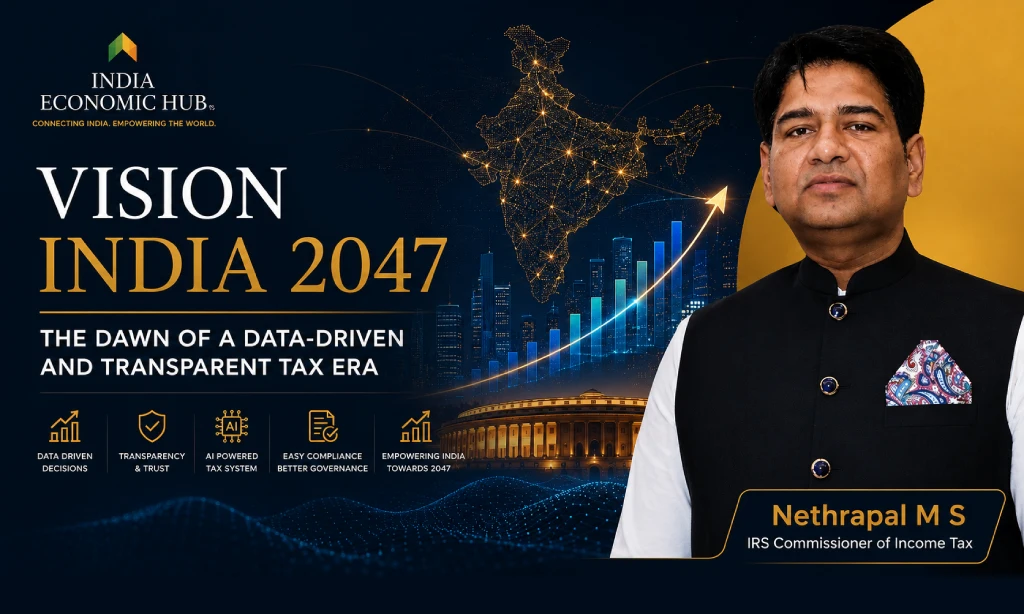

Nethrapal M.S.
IRS Commissioner of Income Tax
As India marches toward its centenary of independence in 2047, the vision of a Viksit Bharat (Developed India) is no longer a distant aspiration but a rapidly materializing reality. In this journey, the Indian Revenue Service (IRS) stands as a robust engine of growth. Over my 16-year tenure, I have seen the department evolve from a system of physical ledgers and “tax melas” to a world-class, technology-first administration.
From “Tax Melas” to Seamless Digitization
When I joined the service, my first posting was in a centralized processing center during a pivotal era of reengineering. At that time, the business return (ITR-4) was a daunting 24-page long document. We worked on a plethora of legislative and procedural changes to simplify these into what we now know as ITR-1 (Sahaj) and ITR-4S (Sugam).
The cultural shift has been profound. We have moved from a time when taxpayers queued up at “tax melas” to file returns, to a modern era where prefilled returns and automated processing mean most citizens get their refunds without ever stepping foot in a tax office.
A Vision for 2047: The “Seamless” Tax Ecosystem
By 2047, I envision an India where tax compliance is an integrated feature of economic life, driven by the following advancements:
1. The End of Data Silos: The 360-Degree Profile
By linking various databases, such as GST and Income Tax, we can create a definitive 360-degree profile of any PAN holder. We are moving toward a model similar to Russia’s retail POS system.
“If you buy a mobile today from a shop, the next day you may receive a message confirming the purchase and verifying that the correct GST and income tax have been accounted for.”
2. AI as a Legal and Investigative Partner
Artificial Intelligence will move beyond simple data processing to become a Tax Digital Legal Assistant.
- Judicial Drafting: AI engines will study legal databases to provide sophisticated legal outputs for complex problem statements.
- Pattern Recognition: Using in-house AI tools like Knime and social media network connectors, we can build connections between related parties and associated assets that traditional rule-based systems would never find.
- Predictive Analytics: Using historical data, we will assign a “likelihood score” of audit risk, allowing us to target limited audit resources at high-risk individuals with surgical precision.
3. Real-Time Intervention and Global Collaboration
The future lies in Real-Time Tax Fraud Detection. With big data and AI, we can intercept suspicious activities immediately, ensuring quicker retrieval of cash and assets before they are moved. On the global stage, collaborative AI engines will make profit shifting to low-tax havens like Ireland or other tax havens extremely difficult. By analyzing mailing systems and ERPs, we can understand a multinational enterprise’s entire value chain in detail, ensuring profits are allocated where the actual functions and risks occur.
Industry-Specific Innovation
The challenges of 2047 will require tailored digital investigation methods for specific sectors:
Logistics & GST: Utilizing GPS details from e-way bills to track the physical transfer of goods in real-time.
Banking & Finance: Using Natural Language Processing (NLP) to verify the authenticity of complex financial documents and identify “red flags” in misrepresented information.
Tech & Pharma: Leveraging the Digital Investigation Evidence Manual—a pioneer SOP that even agencies like the CBI or ED do not currently possess—to handle forensic duplication of digital evidence from large-scale ERP packages.
Conclusion
The success of initiatives like GAAR (General Anti-Avoidance Rule) shows that the department is now better equipped to handle complex business restructuring designed solely to minimize taxes.
My vision for 2047 is an administration that uses “nudge letters” tailored by AI to a taxpayer’s personality type, encouraging voluntary compliance. By leveraging technology to remove friction and AI to ensure fairness, we are building a tax administration that supports India’s $30 trillion economy—where compliance is automatic, and the system is beyond reproach.